









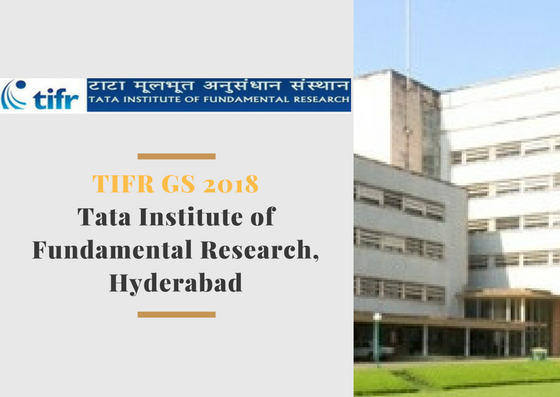
TIFR GS 2027 is also known as the Tata Institute of Fundamental Research Graduate School 2027. This entrance exam is conducted by TIFR Hyderabad at the national level once a year. The exam offers admission to PhD and Integrated M.Sc.-PhD Degree Programmes in the fields of Mathematics, Physics, Chemistry, Biology, Computer & Systems Sciences and Science Education. TIFR (Tata Institute of Fundamental Research) is one of India’s most prestigious research institutions, offering world-class education in science and fundamental research. Candidates who qualify the nationwide entrance examination are called for the interview round, after which final shortlisting is done. Interested candidates can go through the following article for detailed information regarding TIFR GS 2027 admissions, including important dates, eligibility criteria, exam pattern, syllabus, application form and participating institutes.
Still confused about what to do after Class 12?
- Let AI analyse your interests, strengths and goals. Take the Free Career Assessment
TIFR GS 2027 Latest Update as on 05 Sep 2026
Contains
Checked on 05 Sep 2026
TIFR GS 2027, conducted by the Tata Institute of Fundamental Research for PhD/fellowship admissions, has not yet released an official notification; based on past cycles, registration is expected to open around November 2026.
As of 05 September 2026, no official notification for TIFR GS 2027 has been released by the Tata Institute of Fundamental Research (TIFR). The official source material returned no confirming data, and no reliable competitor signal indicates an early release. TIFR GS is a national-level entrance examination for admission to PhD programmes and graduate fellowships across TIFR's various schools and partner institutes. Based on the 2026 cycle, the official notification was published in October 2025, applications opened in November 2025, and the computer-based test was held on 14 December 2025. Students targeting TIFR GS 2027 should therefore watch for a notification on univ.tifr.res.in around October–November 2026, keep academic documents ready, and begin subject-specific preparation now. No changes to syllabus, eligibility, or exam pattern have been officially announced.
- Official notification expected: October–November 2026 (TIFR GS 2026 notification released in October 2025)
- Online application/registration expected to open: ~1 November 2026 (last year: November 2025)
- Application form submission deadline expected: ~late November 2026 (last year: late November 2025)
- Admit card download expected: ~1–2 weeks before exam (last year: December 2025)
- TIFR GS 2027 exam (online) expected: December 2026 (last year: 14 December 2025)
- Result/interview shortlist expected: January–February 2027 (last year: January 2026)
Sources: TIFR Graduate School Official Website
TIFR GS 2027 is an entrance exam for admission to PhD programmes in the areas of Mathematics, Physics, Chemistry, Biology and Computer Science at the Tata Institute of Fundamental Research (TIFR). The exam is conducted as a computer-based test (CBT) in multiple sessions at different centres across India. Candidates are advised to check the official website regularly for the latest notifications related to the TIFR GS 2027 application form, admit card and exam schedule.
Disclaimer: All 2027 dates given below are indicative/expected unless explicitly marked "confirmed (official)". Candidates must verify all details from the official TIFR GS notification at gsadmissions.tifr.res.in before applying.
TIFR GS 2027 Key Highlights
| Detail | Information |
|---|---|
| Exam Name | TIFR GS 2027 |
| Full Name | Tata Institute of Fundamental Research Graduate School |
| Conducting Body | TIFR Hyderabad (on behalf of TIFR) |
| Level | National |
| Mode of Exam | Computer-Based Test (CBT) |
| Frequency | Once a year |
| Programmes Offered | PhD and Integrated M.Sc.-PhD |
| Subjects | Mathematics, Physics, Chemistry, Biology, Computer & Systems Sciences, Science Education |
| Application Form Start (expected) | Early January 2027 |
| Last Date to Apply (expected) | Early February 2027 |
| Entrance Exam Date (expected) | Early March 2027 |
| Result / Shortlist (expected) | Late March 2027 |
| Interviews (expected) | May – June 2027 |
| Official Website | gsadmissions.tifr.res.in |
TIFR GS 2027 Status
The application form for TIFR GS 2027 is expected to be released online in early January 2027 on the official website. Based on the pattern of previous cycles, the last date to apply is expected to fall in early February 2027, the entrance examination is expected to be held in early March 2027, and the shortlist for interviews is expected to be released in late March 2027. All dates are tentative until the official notification is published by TIFR Hyderabad.
| Event | Expected Date (2027 cycle) |
|---|---|
| Release of application form | Early January 2027 (expected) |
| Last date of application | Early February 2027 (expected) |
| Release of admit card | Late February 2027 (expected) |
| Entrance exam | Early March 2027 (expected) |
| Declaration of results / shortlist | Late March 2027 (expected) |
| Interviews | May – June 2027 (expected) |
TIFR GS 2027 Important Dates
Major Changes This Year
No change has been officially announced for TIFR GS 2027 yet; the exam is expected to follow the same pattern as 2026, with an online test likely in December 2026.
No major change has been officially announced yet for TIFR GS 2027. The exam is tentatively expected to retain its existing structure: a single computer-based objective/subjective test, conducted in December, covering subject-specific sections (Mathematics, Physics, Chemistry, Biology, Computer Science, etc.) depending on the programme applied for. Eligibility is expected to remain a Master's or Bachelor's degree in the relevant field. Any confirmed changes to marking scheme, number of subjects offered, or eligibility criteria will appear on the official website once the notification is released, likely in October–November 2026.
The important dates of the TIFR GS 2027 exam are given below. All dates are tentative and based on the schedule followed in the previous (2023) cycle. The official notification will confirm exact dates.
| Event | Expected Dates (Tentative — 2027 cycle) |
| Application Form Start | First week of January 2027 (expected) |
| GATE score-based applications for Systems Science (including Communications and Applied Probability) | Opens: Late January 2027 (expected) | Closes: To be announced |
| Last date for application | First week of February 2027 (expected) |
| Release of admit card | Last week of February 2027 (expected) |
| Entrance Exam | First week of March 2027 (expected) |
| Results of nationwide entrance examination (shortlist for interviews) | Third week of March 2027 (expected) |
Previous Year (2023) Reference — Actual Dates
| Event | 2023 Actual Date |
| Application Form Start | 04 January 2023 |
| Last date for application | 01 February 2023 |
| Release of admit card | 24 February 2023 |
| Entrance Exam | 07 March 2023 |
| Results / shortlist for interviews | 18 March 2023 |
Interview Schedule for TIFR GS 2027 — Mumbai (Expected)
| Subject | Mode of Interview | Tentative Dates (2027) |
| DBS, Biology, I-PhD/M.Sc. | Online / In-person (to be announced) | Late May – Early June 2027 (expected) |
| DBS, Biology, PhD | Online / In-person (to be announced) | Early June 2027 (expected) |
| Chemistry | Online / In-person (to be announced) | Late May – Early June 2027 (expected) |
| Mathematics | To be announced | Early May 2027 (expected) |
| Computer & Systems Sciences | Online / In-person (to be announced) | Mid-June 2027 (expected) |
| Physics | Online / In-person (to be announced) | June 2027 (expected) |
TIFR GS 2027 Analytics & Key Statistics
The following table provides a reference overview of TIFR GS participation and selection trends based on publicly available information from previous cycles. Figures are approximate where exact official data is unavailable; they are intended to give aspirants a sense of competition and selection ratios.
| Parameter | Approx. Figure / Trend | Remarks |
|---|---|---|
| Approximate registered applicants (annual) | ~8,000–12,000 (approx.) | Across all subjects; varies by year |
| Subjects available | 6 | Mathematics, Physics, Chemistry, Biology, CS, Science Education |
| Exam mode | Computer-Based Test (CBT) | Held at centres across India |
| Exam duration | 3 hours | For most subjects |
| Difficulty level | High | Questions at BSc/MSc level; conceptual and analytical |
| Selection stages | 2 (written test + interview) | Written shortlist leads to centre-level interviews |
| Negative marking | Applicable (Physics, Chemistry, CS) | 1 mark deducted per wrong answer in MCQ section |
| PhD monthly stipend (previous cycle) | Rs. 25,000 (initial); Rs. 28,000 (post-registration) | Subject to revision; verify from official notification |
| Integrated PhD monthly stipend (previous cycle, Year 1) | Rs. 16,000 | Increases from Year 2; subject to revision |
Note: Precise seat intake, cut-off marks and selected-candidate counts are not officially published in consolidated form. Candidates are advised to contact individual TIFR centres directly for seat availability information.
TIFR GS 2027 Knowledge Graph
| Exam Full Name | Tata Institute of Fundamental Research Graduate School Examination |
| Acronym | TIFR GS |
| Conducting Body | TIFR Hyderabad (on behalf of TIFR, Mumbai) |
| Parent Institution | Tata Institute of Fundamental Research (TIFR), Mumbai |
| Ministry / Oversight | Department of Atomic Energy (DAE), Government of India |
| Exam Level | National |
| Frequency | Once a year |
| Mode | Computer-Based Test (CBT) |
| Exam Duration | 3 hours (most subjects) |
| Medium / Language | English |
| Programmes Offered | PhD; Integrated M.Sc.-PhD; M.Sc. (Biology — NCBS) |
| Subjects | Mathematics, Physics, Chemistry, Biology, Computer & Systems Sciences, Science Education |
| Official Website | gsadmissions.tifr.res.in |
| TIFR Main Website | www.tifr.res.in |
TIFR GS 2027 Result
The Tata Institute of Fundamental Research releases the result for TIFR GS 2027 on the official website. Based on the previous cycle, results are expected in the third or fourth week of March 2027.
- The TIFR GS result is made available in the form of a merit list.
- It consists of the serial number, application form number, title, name and programme applied for.
- All qualified candidates need to submit the application form, which is further used by the Centres/Institutions to shortlist candidates for on-campus or online interviews.
- Thereafter, call letters/offer letters are issued to selected examinees.
TIFR GS 2027 Counselling
The vital information regarding TIFR GS counselling is given below.
- Counselling for admissions will be conducted for aspirants who are shortlisted in their respective subject channels.
- Seat allotment will be based on factors such as the number of seats available, the rank of the candidate and the preferences filled.
- Counselling will be conducted on the same days for each mode of admission.
- Candidates placed higher in the TIFR GS merit rank will be given more preference during the counselling process.
Documents Required at the Time of Counselling
Candidates need to produce the following original documents along with photocopies at the time of admission, after clearing the entrance examination:
- TC (Transfer Certificate).
- 10th / High School Certificate or equivalent.
- 12th (Intermediate / +2) Certificate or equivalent.
- Migration Certificate.
- Mark sheet of 10th / High School Certificate or equivalent.
- Mark sheets of 12th (Intermediate / +2) Certificate or equivalent.
- Mark sheet of the qualifying examination.
Courses Offered Through TIFR GS 2027
The detailed information on courses offered through TIFR GS 2027 is given below.
| Name of Subject | Name of Programme | Offered At |
| Mathematics | PhD and Integrated M.Sc.-PhD Programmes | 1) School of Mathematics, TIFR Mumbai 2) Centre for Applicable Mathematics (CAM), Bengaluru 3) International Centre for Theoretical Sciences (ICTS), Bengaluru (PhD programme only) |
| Physics | PhD and Integrated M.Sc.-PhD Programmes | 1) Department of Astronomy & Astrophysics 2) Department of Condensed Matter Physics & Materials Science 3) Department of High Energy Physics 4) Department of Nuclear & Atomic Physics 5) Department of Theoretical Physics 6) National Centre for Radio Astrophysics (NCRA), Pune 7) TIFR Centre for Interdisciplinary Sciences (TCIS), Hyderabad 8) International Centre for Theoretical Sciences (ICTS), Bengaluru |
| Chemistry | PhD and Integrated M.Sc.-PhD Programmes | 1) Department of Chemical Sciences, TIFR, Mumbai 2) TIFR Centre for Interdisciplinary Sciences (TCIS), Hyderabad |
| Biology | PhD, Integrated M.Sc.-PhD and M.Sc. Programmes | 1) Department of Biological Sciences, TIFR, Mumbai 2) National Centre for Biological Sciences (NCBS), Bengaluru — PhD, Integrated M.Sc.-PhD and M.Sc. (Wildlife Biology & Conservation) 3) TIFR Centre for Interdisciplinary Sciences (TCIS), Hyderabad — PhD and Integrated M.Sc.-PhD only |
| Computer & Systems Sciences (including Communications and Applied Probability) | PhD Programme only | School of Technology & Computer Science (STCS), TIFR, Mumbai |
| Science Education | PhD Programme | Homi Bhabha Centre for Science Education (HBCSE), Mumbai |
Stipend for Students Pursuing PhD from TIFR
A monthly stipend is provided to candidates pursuing their degree from TIFR. The following figures are from the previous cycle and may be revised for 2027 — candidates must verify the current stipend structure from the official notification:
- PhD: Students receive a monthly scholarship of Rs. 25,000/- (increased to Rs. 28,000/- after registration) and an annual contingency grant of Rs. 32,000/-.
- Integrated PhD: Students receive a monthly scholarship of Rs. 16,000/- in the first year, increasing to Rs. 25,000/- from the second year onwards (further increased to Rs. 28,000/- after registration), with an annual contingency grant of Rs. 20,000/- (increased to Rs. 32,000/- from the second year).
TIFR GS 2027 Application Form
The detailed information regarding the TIFR GS 2027 application form is given below.
- The application form for TIFR GS 2027 is expected to be released online in early January 2027 on the official website.
- Applications will be accepted through online mode only; no offline application form will be released by the conducting body.
- Candidates must fill a separate application form for each subject they wish to apply for.
- Multiple application forms submitted by a single candidate for the same subject will be rejected by the conducting body.
- Applicants must fill the form carefully because the conducting body does not provide any correction window.
TIFR GS 2027 Application Fee
The application fee structure for TIFR GS is given below. Candidates should verify the exact fee from the official 2027 notification, as fees may be revised.
| Gender | Application Fee |
|---|---|
| Male | Rs. 900/- (previous cycle; subject to revision) |
| Female | Rs. 300/- (previous cycle; subject to revision) |
Mode of Payment: Candidates can pay the application fee through online mode only, via Internet Banking, Debit Card or Credit Card.
NOTE: No refund of application fee will be entertained by the conducting body under any circumstances.
How to Apply for TIFR GS 2027?
The procedure for filling the TIFR GS 2027 application form is given below.
- Visit the official website at gsadmissions.tifr.res.in.
- Select the Notifications link on the official website to check for the latest TIFR GS 2027 notification.
- Register by clicking on the Admissions link on the homepage of the website.
- Fill the online application form with all necessary personal and academic details.
- Enter all details such as name, date of birth and other required information correctly and as per supporting documents.
- Upload a thumb impression, signature, photograph and other applicable documents online in the specified quality and size.
- Pay the application fee online as described above.
- After payment is completed, review the application form thoroughly and submit it.
TIFR GS 2027 Eligibility Criteria
The following are the eligibility criteria for TIFR GS 2027. Candidates are strongly advised to read the official notification for subject-specific and programme-specific requirements before applying.
- The candidate must have passed 12th standard with a minimum of 50% marks in Physics, Chemistry and Mathematics.
- The candidate must hold a bachelor’s degree in a relevant discipline from a recognised university.
The detailed eligibility criteria for TIFR GS 2027 are given below.
- Nationality: The candidate should be an Indian national. Foreign nationals may also apply; details are available in the official prospectus.
- Educational Qualification: The candidate must have cleared their 12th standard from a recognised board.
- Marks Required: Aspirants must have secured at least 60% aggregate marks in their qualifying examination.
- Mandatory Subjects: The candidate must have studied Physics, Mathematics and English at the 10+2 level.
- Age Limit: There is no upper or lower age limit for the TIFR GS examination.
- Programme-specific eligibility criteria are as follows:
- PhD: Candidates must have completed M.Sc. (Physics) / B.Tech. or B.E. (Engineering Physics) / B.E. / B.Tech. / M.Tech. or an equivalent science, engineering or medical degree with a minimum of four years of university training.
- Integrated M.Sc.-PhD: Candidates must have completed B.Sc. / B.E. / B.Tech. / B.Pharm. or an equivalent science, engineering or medical degree; or M.Sc. (other than Physics) / M.Tech. / M.Pharm. / MBBS or an equivalent science, engineering or medical master’s degree.
TIFR GS 2027 Exam Pattern
The detailed information regarding the TIFR GS 2027 exam pattern is given below. The pattern is based on previous cycles; any changes will be communicated in the official 2027 notification.
TIFR GS Exam Pattern for Mathematics
| Duration | 3 hours |
| Type of Questions | Objective-type MCQ and True/False questions |
| Number of Questions | 20 True/False and 20 MCQs |
| Standard of the Test | B.Sc. course in Mathematics |
TIFR GS Exam Pattern for Physics
| Type of Questions | Objective-type MCQ |
|---|---|
| Standard of the Questions | Undergraduate and Masters levels at an Indian university |
| Marking Scheme | 3 marks for each MCQ; 5 marks for Numerical and Symbolic questions |
| Negative Marking | 1 mark deducted per incorrect answer in the MCQ section |
TIFR GS Exam Pattern for Chemistry
| Type of Questions | Objective-type MCQ |
|---|---|
| Number of Questions | 40 |
| Duration | 3 hours |
| Marking Scheme | 3 marks awarded for each correct answer |
| Negative Marking | 1 mark deducted for each incorrect answer |
TIFR GS Exam Pattern for Biology
| Type of Questions | Objective-type MCQ |
|---|---|
| Standard of the Test | Mathematics, Physics, Chemistry and Biology at undergraduate level |
TIFR GS Exam Pattern for Computer & Systems Sciences
| Section | Three-part paper |
|---|---|
| Duration of the Exam | 3 hours |
| Type of Questions | MCQ |
| Negative Marking | 1 mark deducted for each incorrect attempt |
TIFR GS 2027 Syllabus
The detailed information regarding the TIFR GS 2027 syllabus is given below. Candidates preparing for the TIFR GS written test should pay special attention to conceptual understanding at the BSc and MSc level, as the exam is known for testing analytical and problem-solving ability rather than rote knowledge.
TIFR GS 2027 Syllabus for Mathematics
- Algebra: Definitions and examples of groups (finite and infinite, commutative and non-commutative), cyclic groups, subgroups, homomorphisms, quotients. Definitions and examples of rings and fields. Basic facts about vector spaces, matrices, determinants, ranks of linear transformations, characteristic and minimal polynomials, symmetric matrices. Integers and their basic properties. Inner products, positive definiteness.
- Analysis: Basic facts about real and complex numbers, convergence of sequences and series of real and complex numbers, continuity, differentiability and Riemann integration of real-valued functions defined on an interval (finite or infinite), elementary functions (polynomial functions, rational functions, exponential and logarithm, trigonometric functions), sequences and series of functions and their different types of convergence, ordinary differential equations.
- Geometry/Topology: Elementary geometric properties of common shapes and figures in 2- and 3-dimensional Euclidean spaces (e.g., triangles, circles, discs, spheres). Plane analytic geometry (coordinate geometry) and trigonometry. Definition and basic properties of metric spaces, examples of subsets of Euclidean spaces (of any dimension), connectedness, compactness. Convergence in metric spaces, continuity of functions between metric spaces.
- General: Pigeonhole principle (box principle), induction, elementary properties of divisibility, elementary combinatorics (permutations and combinations, binomial coefficients), elementary probability theory, elementary reasoning with graphs.
TIFR GS 2027 Syllabus for Physics
The questions in the written test (multiple-choice type) and the interview are distributed over the following areas:
- Classical Mechanics
- Mathematics relevant to Physics
- Electricity and Magnetism
- Quantum Mechanics
- Heat, Thermodynamics and Statistical Physics
- General Physics
- Modern Physics
- Electronics and Experimental Physics
TIFR GS 2027 Syllabus for Chemistry
The syllabus for the written test in Chemistry is similar to the standard syllabus followed in Indian universities for BSc and MSc degree courses. Questions are asked in the areas of physical, organic, inorganic, analytical, electrochemistry and quantum chemistry, biophysics, thermodynamics, spectroscopy (NMR, fluorescence, IR, UV and X-ray), logic and statistics, and mathematical methods.
TIFR GS 2027 Syllabus for Computer & Systems Sciences
- Discrete Mathematics: Sets and relations, combinatorics (counting) and elementary probability theory, graph theory, propositional and predicate logic.
- Formal Languages, Automata Theory and Computability.
- Data Structures and Algorithms: Arrays, lists and trees, sorting and searching, graph algorithms, complexity of problems and NP-completeness.
- Fundamentals of Programming Languages and Compilers: Control structures, parameter-passing mechanisms, recursion, parsing and type checking, memory management.
- Operating Systems and Concurrency.
- Switching Theory and Digital Circuits.
- Theory of Databases.
The topics under Systems Science are as follows:
- Engineering Mathematics: Complex analysis, linear algebra, elementary numerical analysis, basic optimisation theory and algorithms, introduction to probability theory and statistics.
- Electrical and Computer Sciences: Introduction to signals and linear systems analysis, control systems, digital signal processing, basic circuit theory, introduction to digital communications, digital computer fundamentals, introduction to computer programming.
TIFR GS 2027 Preparation Tips
Applicants can refer to the following tips on how to prepare effectively for the TIFR GS 2027 entrance examination.
- Solve previous years’ TIFR GS question papers to understand the pattern, difficulty level and frequently tested concepts.
- Revise NCERT textbooks thoroughly, as foundational concepts are heavily tested.
- Maintain a separate formula book for Mathematics, Physics and Chemistry for quick revision.
- Candidates can use the IIT JAM syllabus as an additional guide for subject coverage in TIFR GS preparation.
- Focus on conceptual clarity and analytical problem-solving rather than memorisation, as the exam emphasises application of knowledge.
TIFR GS 2027 Admit Card
The detailed information regarding the TIFR GS 2027 admit card is given below. Based on the previous cycle, the admit card is expected to be released in the last week of February 2027.
- The admit card will be released through online mode on the official website.
- To download the admit card, candidates must log in using their user ID and password.
- The admit card is a mandatory document that must be carried on the day of the test; candidates without a valid admit card will not be permitted to sit the exam.
- The admit card will contain the candidate’s personal details as well as exam details such as the date of the test, reporting timings and the address of the test centre.
TIFR GS 2027 Examination Centres
The list of examination centres for TIFR GS 2027 is expected to be similar to previous cycles, subject to changes announced in the official notification. The centres listed below are based on the previous cycle for reference.
| Examination Centre | Location |
| St. Xavier’s College | Ahmedabad |
| Punjab University | Chandigarh |
| University of Agricultural Sciences | Bhubaneswar |
| Indian Institute of Technology | Chennai |
| Kendriya Vidyalaya (JNU Old Campus) | New Delhi |
| Cochin University of Science & Technology | Kochi |
| SGTB Khalsa College | New Delhi |
| Kendriya Vidyalaya (Pragati Vihar) | New Delhi |
| Indian Institute of Technology | Guwahati |
| Kendriya Vidyalaya (R.K. Puram) | New Delhi |
| Indira Priyadarshini Government Girls P.G. College of Commerce | Haldwani |
| University of Hyderabad | Hyderabad |
| India International School | Jaipur |
| Devi Ahilya Vishwavidyalaya | Indore |
| Kendriya Vidyalaya (Salt Lake) | Kolkata |
| Jammu University | Jammu |
| Kendriya Vidyalaya (Fort William) | Kolkata |
| Indian Institute of Technology | Kanpur |
| South Calcutta Girls’ College | Kolkata |
| Basanti Devi College | Kolkata |
| The Madura College | Madurai |
| University College, Hampanakatta | Mangalore |
| Kendriya Vidyalaya No. 1, Colaba | Mumbai |
| Dr D.Y. Patil Pushpalata Patil International School | Patna |
| Shri Ramdeo Baba Kamla Nehru Engineering College | Nagpur |
| Loyola High School and Junior College | Pune |
| Banaras Hindu University | Varanasi |
| GITAM Institute of Science | Visakhapatnam |
Participating Institutes under TIFR GS 2027
Mathematics (PhD & Integrated M.Sc.-PhD Programmes)
| S.No. | Centre Name | Location | Website |
| 1. | School of Mathematics, TIFR | Mumbai | www.math.tifr.res.in |
| 2. | Centre for Applicable Mathematics (CAM) | Bengaluru | math.tifrbng.res.in |
| 3. | International Centre for Theoretical Sciences (ICTS) (PhD only) | Bengaluru | www.icts.res.in |
Physics (PhD & Integrated M.Sc.-PhD Programmes)
| S.No. | Centre Name | Location | Website |
| 1. | National Centre for Radio Astrophysics (NCRA) | Pune | www.ncra.tifr.res.in |
| 2. | TIFR Centre for Interdisciplinary Sciences (TCIS) | Hyderabad | www.tifrh.res.in |
| 3. | International Centre for Theoretical Sciences (ICTS) (PhD only) | Bengaluru | www.icts.res.in |
| 4. | TIFR | Mumbai | www.tifr.res.in |
NOTE: In addition to admissions through the nationwide entrance examination, some admissions in Physics based on GATE / NET / JEST scores are also possible. Candidates should check the official notification for details on GATE-score-based admissions for TIFR GS 2027.
Chemistry (PhD and Integrated M.Sc.-PhD Programmes)
| S.No. | Centre Name | Location | Website |
| 1. | Department of Chemical Sciences, TIFR | Mumbai | www.tifr.res.in |
| 2. | TIFR Centre for Interdisciplinary Sciences (TCIS) | Hyderabad | www.tifrh.res.in |
Biology (PhD, Integrated M.Sc.-PhD & M.Sc. Programmes)
| S.No. | Centre Name | Location | Website |
| 1. | Department of Biological Sciences, TIFR | Mumbai | www.tifr.res.in |
| 2. | National Centre for Biological Sciences (NCBS) | Bengaluru | www.ncbs.res.in |
| 3. | TIFR Centre for Interdisciplinary Sciences (TCIS) | Hyderabad | www.tifrh.res.in |
Computer & Systems Sciences (PhD programme including Communications and Applied Probability)
| S.No. | Centre Name | Location | Website |
| 1. | School of Technology & Computer Science (STCS), TIFR | Mumbai | www.tifr.res.in |
Science Education (PhD Programme)
| S.No. | Centre Name | Location | Website |
| 1. | Homi Bhabha Centre for Science Education (HBCSE) | Mumbai | www.hbcse.tifr.res.in |
TIFR GS 2027 Highlights
The key details regarding TIFR GS 2027 are summarised below.
| Exam Name | TIFR GS |
|---|---|
| Full Name | Tata Institute of Fundamental Research Graduate School |
| Conducting Body | TIFR Hyderabad |
| Level | National |
| Programmes Offered | PhD and Integrated M.Sc.-PhD Degree Programmes |
| Official Website | gsadmissions.tifr.res.in |
Official Sources
- https://gsadmissions.tifr.res.in/ — Official TIFR GS Admissions Portal
- https://www.tifr.res.in/ — TIFR Main Website
- https://www.tifrh.res.in/ — TIFR Hyderabad (TCIS)
- https://www.ncbs.res.in/ — National Centre for Biological Sciences, Bengaluru
- https://www.ncra.tifr.res.in/ — National Centre for Radio Astrophysics, Pune
- https://www.icts.res.in/ — International Centre for Theoretical Sciences, Bengaluru
- https://www.hbcse.tifr.res.in/ — Homi Bhabha Centre for Science Education, Mumbai
Conclusion
TIFR GS 2027 is one of India’s most prestigious research-admission examinations, offering entry to PhD and Integrated M.Sc.-PhD programmes in Mathematics, Physics, Chemistry, Biology, Computer & Systems Sciences and Science Education across TIFR’s premier campuses. Aspirants should begin their preparation early, focussing on BSc- and MSc-level concepts, solving previous years’ papers and tracking the official portal. The application form is expected in January 2027 and the entrance exam in March 2027 — always verify the confirmed dates from the official TIFR GS notification at gsadmissions.tifr.res.in before submitting your application.
Frequently Asked Questions
When will the TIFR GS 2027 application form be released?
Based on the schedule followed in previous cycles, the TIFR GS 2027 application form is expected to be released in the first week of January 2027. Candidates should keep checking the official website at gsadmissions.tifr.res.in for the official notification and confirmed dates.
What is the eligibility criteria for TIFR GS 2027 PhD programme?
For the PhD programme, candidates must have completed an M.Sc. (Physics), B.Tech./B.E. (Engineering Physics), B.E./B.Tech./M.Tech. or an equivalent science, engineering or medical degree with a minimum of four years of university training. A minimum of 60% aggregate marks in the qualifying examination is generally required.
Is there negative marking in TIFR GS 2027?
Yes, negative marking applies in the Physics, Chemistry and Computer & Systems Sciences papers. One mark is deducted for each incorrect answer in the MCQ section. The Mathematics paper consists of MCQs and True/False questions; candidates should check the official notification for the exact marking scheme applicable in 2027.
Can I apply for more than one subject in TIFR GS 2027?
Candidates must fill a separate application form for each subject they wish to apply for. However, submitting multiple forms for the same subject will result in rejection. Candidates should carefully read the subject-specific eligibility criteria before applying for more than one subject.
What is the stipend for PhD students at TIFR?
Based on the previous cycle, PhD students at TIFR receive a monthly stipend of Rs. 25,000/-, which increases to Rs. 28,000/- after registration. An annual contingency grant of Rs. 32,000/- is also provided. These figures are subject to revision for the 2027 cycle; candidates should verify from the official notification.
What is the TIFR GS 2027 exam date?
The TIFR GS 2027 entrance examination is expected to be held in the first week of March 2027, based on the pattern from previous cycles (the 2023 exam was held on 07 March 2023). The confirmed exam date will be available in the official 2027 notification on the TIFR GS website.
Are GATE or NET scores accepted for TIFR GS 2027 admissions?
Yes, TIFR accepts GATE/NET/JEST scores for certain admissions, particularly in Physics and Systems Science. For Systems Science (including Communications and Applied Probability), GATE score-based applications are opened separately. Candidates who have valid GATE or NET scores should check the official notification for programme-specific details.
How many exam centres are available for TIFR GS 2027?
Based on the previous cycle, TIFR GS was conducted at approximately 28 centres across India, spanning cities including Mumbai, Delhi, Bengaluru, Hyderabad, Kolkata, Chennai, Pune, Jaipur, Indore, Guwahati, Varanasi and Visakhapatnam, among others. The official list of exam centres for 2027 will be published with the admit card / official notification.




I want to do integrated M.Sc -Ph.D in Biology .What’re requisites.
Ok
Int msc phd ka Maine form uply kiya but fee kha pay kare sir plz bhaiya tifr college mumbai
I am mathematics student reading in 2nd year. Am I elligible for tifr gs2021 exam?
why there is no exam center in chhattishgarh?
Can u please place a center at kozhikode
Can u please place a center at kozhikode
what is the syllabus of msc. in biology and exam pattern
No Official Center in Jammu
When the registration will start for tifr msc entrance
There is a problem with 10th standard year of passing. The maximum year it is showing 2010. Did anyone else faced the same issue?
what to do if i filled wrong dob by mistake
should I fill the application again? because I paid already
Please look for application correction details or may write to Tata Institute of Fundamental Research admission department.
I have done my 12th class with physics, chemistry and biology, English only .
am I eligible to give tifr entrance exam for msc in wildlife sciences.