








CSAS 2027 — the Common Seat Allocation System for University of Delhi undergraduate admissions — has not yet been officially notified; the 2026 cycle serves as the verified baseline for all schedule references on this page. This guide covers what CSAS is, how its three phases work, the full form of CSAS, registration and document requirements, tie-breaking rules, the auto-upgrade and freeze options, mid-entry provision, subject mapping, simulated merit lists, and the withdrawal and refund policy — everything a student needs to plan their Delhi University admission 2027 before the official notification goes live on du.ac.in.
Still confused about what to do after Class 12?
- Let AI analyse your interests, strengths and goals. Take the Free Career Assessment
CUET UG 2027 Latest Update as on 08 Nov 2026
Contains
Checked on 08 Nov 2026
CUET UG 2027 has no official notification or application schedule yet; NTA has only published CUET-UG 2026-related updates, so students should watch the official NTA portal for the 2027 application notice and conduct details.
As of 08 Nov 2026, CUET UG 2027 has not received an official application notification from NTA, and the public CUET portal currently reflects only CUET-UG 2026 notices. That means the 2027 cycle is still at the pre-notification stage, with no confirmed registration dates, exam dates, or eligibility changes yet. Students should keep checking the official NTA website for the first 2027 application notice and bulletin, because that will confirm the schedule and process. Based on the previous-year pattern, the next step is usually the release of the application form, followed by the exam calendar and admit card updates. For now, aspirants should prepare documents, keep scanned files ready, and track CUET UG 2027 updates on cuet.nta.nic.in. Official website: cuet.nta.nic.in.
- NTA’s official CUET portal currently shows only CUET-UG 2026 notices, including final answer keys, provisional answer keys, exam conduct updates, admit card notices, and rescheduling-related notices.
- The official source material does not confirm any CUET UG 2027 application form, exam date, syllabus change, or eligibility update as of 08 Nov 2026.
- The official-site change detected today indicates the article should answer the CSAS full form directly in the 2027 section using official evidence only; no official CUET UG 2027 announcement is attached to that signal.
- Registration for CUET UG 2027 is expected to open after the official notification, likely around the usual pre-exam window seen in prior years, but this is not confirmed.
- The information bulletin and application schedule are expected to follow the registration notice, as in earlier CUET cycles.
- Admit cards are typically released closer to the exam date after the application window closes, but no 2027 date is official yet.
- The exam schedule is expected to be announced by NTA before the test window, following the previous-year pattern, but 2027 dates are unconfirmed.
- DU’s CSAS UG counselling phase is expected to start after CUET results, but the 2027 counselling timeline has not been officially announced yet.
Article Status: 2027 Notification Awaited. No official 2027 CSAS notification has been published by the University of Delhi as of the date of this update. Every 2027 date on this page is Tentative — Not Officially Announced and is based on the 2026 cycle as a verified reference. All 2026 reference dates are labelled clearly. Check du.ac.in for the authentic notification.
| Attribute | Detail |
|---|---|
| Full Name | Common Seat Allocation System |
| Acronym (Full Form of CSAS) | CSAS = Common Seat Allocation System |
| Conducting Body | University of Delhi (DU), Admission Branch |
| Supported by | National Testing Agency (NTA) for CUET UG score integration |
| Parent Ministry | Ministry of Education, Government of India |
| Admission Level | Undergraduate (UG) |
| Frequency | Annual |
| Mode | Online — centralised CSAS portal |
| Basis of Admission | CUET UG score (from 2022 onwards); Class 12 marks used for tie-breaking and subject mapping |
| Official Website | du.ac.in |
| CUET UG Official Site | cuet.nta.nic.in |
| Helpline | Published on du.ac.in at the time of notification (check portal for 2027 contact details) |
| 2027 Status | Awaiting official notification |
Key Highlights: CSAS 2027
| Particulars | Details | Status |
|---|---|---|
| Process Name | Common Seat Allocation System (CSAS) 2027 — DU UG Portal 2027 | Confirmed |
| Conducting Body | University of Delhi (DU) | Confirmed |
| Level | Undergraduate (UG) | Confirmed |
| Mode | Online (centralised portal) | Confirmed |
| CUET UG 2026 Exam Conducted | 11 May 2026 onwards (confirmed by NTA press briefing) | Confirmed — 2026 reference |
| CUET UG 2027 Exam | Awaiting NTA notification; expected May–June 2027 | Tentative — Not Officially Announced |
| Phase I: CSAS Registration Opens | Expected late May / early June 2027 (after CUET UG 2027 results) | Tentative — Not Officially Announced |
| Phase II: College & Course Preference Filling | Expected June–July 2027 (after Class 12 results declared) | Tentative — Not Officially Announced |
| Phase III: Seat Allocation Round 1 | Expected July 2027 | Tentative — Not Officially Announced |
| Subsequent Allocation Rounds | Expected August–September 2027 | Tentative — Not Officially Announced |
| Spot / Final Round | Expected October 2027 | Tentative — Not Officially Announced |
| Official Website | du.ac.in | Confirmed |
Disclaimer: All 2027 dates are indicative and based on the 2026-cycle schedule as the verified baseline. They will be confirmed only upon release of the official CSAS 2027 notification on du.ac.in. Students must check the official portal regularly.
What is CSAS? (Full Form and Definition)
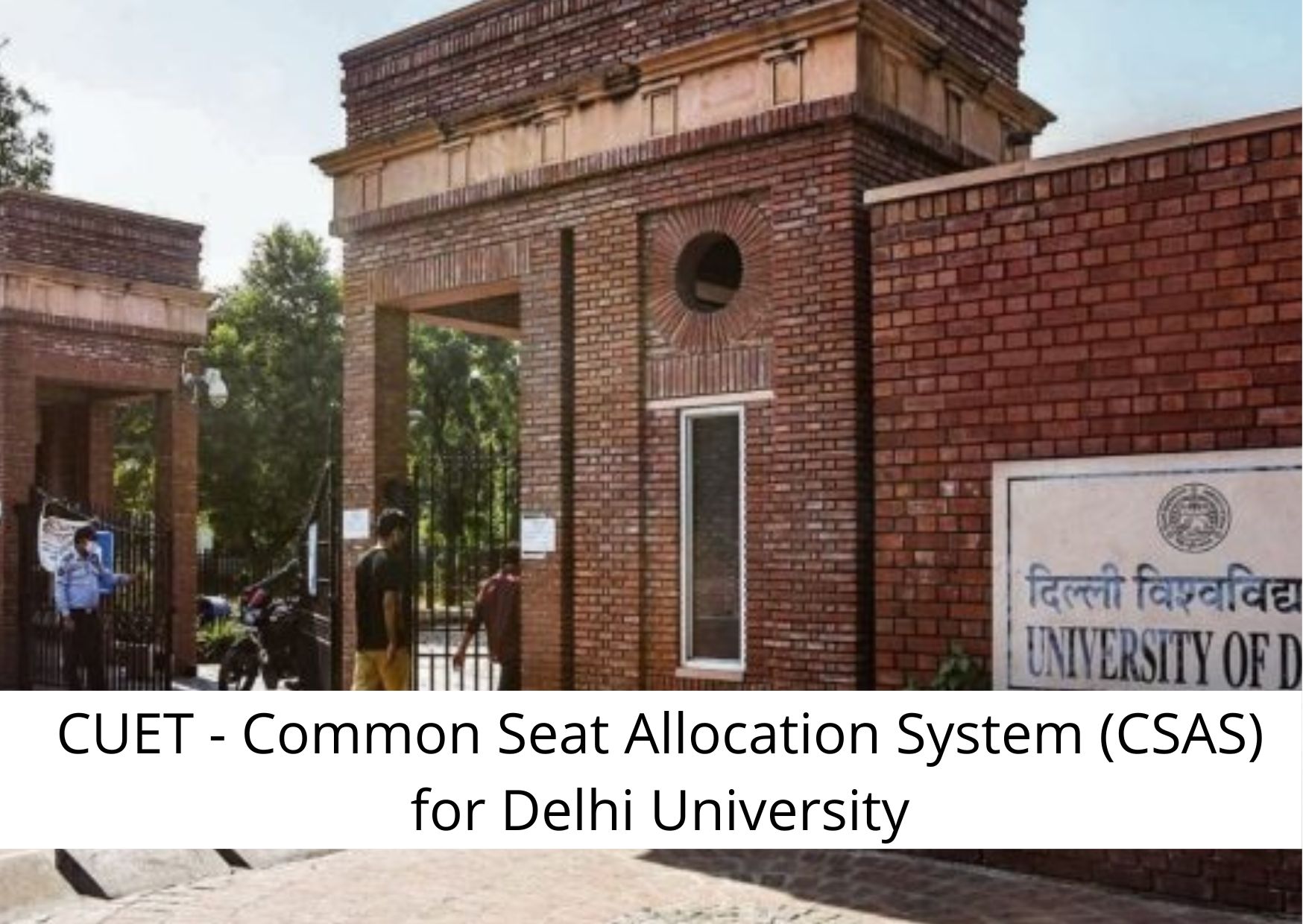
CSAS stands for Common Seat Allocation System — an online admissions platform used exclusively by the University of Delhi to allocate undergraduate seats across its affiliated colleges. The system builds a centralised merit list using CUET UG scores (and Class 12 marks where applicable), then runs a computerised matching process against each applicant’s college and course preferences. CSAS replaced the older college-specific cut-off list system and brought all DU UG admissions under a single, transparent platform managed by DU’s Admission Branch.
Students searching for what is CSAS, the full form of CSAS, or simply CSAS full form in Delhi University will find that it always refers to the Common Seat Allocation System — there is no other expansion in the DU admissions context. The University Grants Commission (UGC) has encouraged central universities to adopt CUET-linked centralised allocation, and DU’s CSAS is the leading example of that model.
Overview of the Common Seat Allocation System (CSAS)
Major Changes This Year
No official change for CUET UG 2027 has been announced yet; based on the last cycle, the next expected step is the NTA application notification, but that timing remains unconfirmed.
No major change has been officially announced yet for CUET UG 2027. The official material available today only contains CUET-UG 2026 notices, so there is no confirmed update on application dates, exam pattern, syllabus, eligibility, or mode for the 2027 cycle. Any timeline for registration or counselling is still tentative and should be treated as an expectation based on the previous year’s sequence, not as an official schedule. Students should wait for the NTA notification before relying on any date, process change, or admission step.
The Common Seat Allocation System is a centralised platform that streamlines the process of finding and securing a college seat across the University of Delhi’s network of affiliated colleges. It allows students to submit their choices of college, course and specialisation in one go, making it the most time-efficient route to DU undergraduate admissions 2027. CSAS reduces duplication of effort: instead of applying to dozens of colleges individually, a student fills a single preference list and the algorithm does the matching.
The portal covers both aided and unaided programmes, including popular streams such as B.A., B.Sc., B.Com., B.A. (Hons.), B.Com. (Hons.) and vocational courses offered by colleges such as the College of Vocational Studies. Because preferences are submitted once and processed centrally, students can list as many programme-college combinations as they wish within the portal, ranking them in order of priority before Phase III begins.
The Three Phases of CSAS — How the Process Works
Understanding the three-phase structure is essential before beginning CSAS Phase 1 registration. Each phase has a distinct purpose, and missing any one of them can lock a student out of the entire cycle.
Phase I — Registration on the CSAS Portal
In Phase I, eligible students register on the DU admissions portal by entering personal details, academic information and their CUET UG 2027 application number. The registration fee (2026 reference: ₹250 for General / OBC-NCL / EWS candidates; ₹100 for SC / ST / PwBD candidates — 2027 fee awaiting official confirmation) is paid online. After submitting, the portal generates an applicant dashboard with step-by-step instructions for the subsequent phases. Students should keep their CUET UG 2027 scorecard and Class 12 mark sheet ready before logging in.
Phase II — College and Course Preference Filling
Phase II opens after Class 12 board results are declared and CUET UG scores are released. During CSAS Phase 2 preference filling, students select and rank their desired programme-college combinations from the list of participating DU colleges. A student can add or modify preferences until the Phase II window closes — this is also when the portal displays a simulated merit list so applicants can judge how competitive their CUET score is against the preferences they have entered (see the dedicated section below). No seat is locked at this stage; it is purely a preference exercise.
Phase III — Seat Allocation Rounds
Phase III is the actual CSAS Phase 3 seat allocation stage. The DU portal runs multiple allocation rounds (typically four to five, including a spot round), each producing an offer letter. After each round, a student must choose one of three responses within the stipulated acceptance window:
- Freeze — Accept the allotted seat and withdraw from all future rounds. The seat is confirmed.
- Float (Auto-Upgrade) — Accept the current allotment tentatively but remain in the pool for a potentially better allotment in the next round. If a better preference is available, the system auto-upgrades; otherwise the current seat is retained.
- Slide — Retain the allotted college but allow the system to try for a better programme within the same college in the next round.
Failure to respond within the acceptance window forfeits the allotted seat, so applicants must monitor the portal daily during Phase III.
Previous Year (2026) Reference: CSAS UG Schedule
| Event | 2026 Reference Date | 2027 Expectation |
|---|---|---|
| CUET UG Exam Begins | 11 May 2026 (confirmed — NTA press briefing) | Expected May–June 2027 (Tentative) |
| Phase I Registration Opens | Announced by DU after CUET UG results (2026) | Expected late May / early June 2027 (Tentative) |
| Phase II: College & Course Preferences | Announced by DU after board results (2026) | Expected June–July 2027 (Tentative) |
| Round 1 Seat Allocation | Announced by DU (2026) | Expected July 2027 (Tentative) |
| Spot / Final Allocation Round | Spot Round allotment released (2026 — Sarvgyan coverage) | Expected October 2027 (Tentative) |
Source: 2026 dates sourced from the NTA official notice for CUET UG 2026 commencement (cuet.nta.nic.in) and publicly available DU cycle references. Precise 2026 event dates should be verified on du.ac.in before use as a formal reference. All 2027 dates are Tentative — Not Officially Announced.
Subject Mapping for CSAS 2027 (CUET vs Class 12)
Subject mapping is one of the most misunderstood parts of the CUET DU admission process. Each DU programme specifies which CUET UG subject paper a candidate must have appeared in. The portal automatically maps a student’s CUET subject scores to the programmes they are eligible for — but students must verify this before finalising preferences in Phase II.
- For B.A. (Hons.) History, a candidate typically needs to have appeared in the History domain subject paper in CUET UG, alongside the Language paper.
- For B.Sc. (Hons.) Physics, the relevant CUET domain papers are Physics, Mathematics and Chemistry (or combinations as specified by DU).
- For B.Com. (Hons.) and B.Com., the Mathematics / Applied Mathematics and Accountancy papers are generally mapped.
- Class 12 stream and subject combination can further restrict eligibility for certain programmes — for example, a student from the Arts stream cannot claim eligibility for a Science (Hons.) programme even with a high CUET score in a Science domain paper, unless DU’s programme-specific eligibility allows it.
Always cross-check the DU Programme-Specific Eligibility Criteria (PSEC) document published on du.ac.in for each cycle. The 2027 PSEC has not yet been released; use the 2026 PSEC as a reference only.
Tie-Breaking Rules for DU CSAS 2027
When two or more applicants have identical CUET UG scores for the same programme-college combination, the University of Delhi applies a defined set of tie-breaking criteria. Based on the 2026 cycle (as a reference — 2027 rules are Awaiting official notification):
- Higher aggregate CUET UG score across all papers attempted by the candidate.
- Higher marks in the specific CUET domain subject relevant to the programme applied for.
- Higher Class 12 marks in the best-of-four or programme-relevant subjects, as defined in the DU eligibility criteria.
- Date of birth — the older candidate gets preference in the event of a continuing tie.
The DU CSAS tie-breaking rules are published as part of the official admission bulletin each year. Students within a few decimal points of a cut-off should read the bulletin carefully before deciding whether to Float or Freeze after Round 1.
Simulated Merit List in DU CSAS — What It Means
The simulated merit list is a planning tool made available during Phase II. After a student enters their programme-college preferences, the portal displays a provisional rank based on their CUET score against that preference’s current demand. This is not a final allotment — it is a simulation that reflects relative standing at a given point in time and changes as more students add or modify preferences.
Students should use the simulated merit list to:
- Identify whether a programme-college combination is realistic, ambitious or a safe choice.
- Reorder preferences strategically before the Phase II window closes.
- Avoid listing only high-demand programmes and overlooking viable options lower in the preference list.
The simulated list is refreshed periodically during the Phase II window. Its final snapshot before Phase III begins gives the best indication of likely allotment, though it remains subject to change until official seat allocation.
Mid-Entry Provision in DU CSAS
The mid-entry provision allows students whose Class 12 results were delayed — due to compartment examinations, board result revisions or other administrative reasons — to register on the CSAS portal after the standard Phase I window closes, subject to DU’s specific conditions. Mid-entry registrations are accepted only within the official mid-entry window announced by the University.
Key points about mid-entry:
- Mid-entry candidates can still participate in later allocation rounds, though they may miss Round 1.
- The portal flags mid-entry applications separately; document verification timelines may differ.
- DU announces mid-entry dates in the official admission schedule — they are not an open-ended extension of Phase I.
The 2027 mid-entry window is Awaiting official notification. Students in compartment or delayed-result situations should monitor du.ac.in closely once the main schedule is published.
How to Register for CSAS 2027
To participate in the CSAS 2027 programme, applicants must first fill out an online registration form on the official University of Delhi admissions portal. This requires entering contact information and an academic profile, including Class 12 marks, stream details and the CUET UG 2027 application or roll number. After submitting the registration form, the portal generates an applicant dashboard with step-by-step instructions for completing the rest of the DU CSAS UG registration 2027 process.
Once all required documents have been reviewed and uploaded, the portal displays a personalised list of eligible colleges along with an eligibility status report. Students are advised to keep their Class 12 mark sheet and CUET UG 2027 scorecard ready before starting registration, and to double-check that their name and date of birth match across both documents to avoid mismatches during verification.
What Documents Are Required for the CSAS Portal 2027?
Applicants must provide the following documents to complete the CSAS 2027 registration process: proof of age, a valid identity photo, and either a Class 12 (senior secondary) mark sheet or proof of equivalent educational attainment. Additional documents may be required depending on category, sports or ECA claims and the specific programme’s eligibility conditions. Verify all documents before uploading to avoid rejection during the document verification for DU admissions 2027.
- Class 12 mark sheet / passing certificate
- Date of birth proof (Aadhaar card / birth certificate)
- Recent passport-size photographs (as per portal specifications)
- Category certificate (SC / ST / OBC-NCL / EWS / PwBD), if applicable
- Sports / ECA certificates, if claiming supernumerary seats
- Character / migration certificate (may be required at the college level on admission)
- CUET UG 2027 scorecard
- Fee payment receipt (generated after online payment on the portal)
CSAS Correction Window — Scope and What Can Be Changed
DU typically provides a correction window during or after Phase I registration, allowing applicants to fix specific details before preferences are locked in Phase II. Based on the 2026 cycle (2027 scope is Awaiting official notification), corrections generally permitted include:
- Uploaded photograph or signature (if rejected by the system)
- Category certificate details (subject to document re-verification)
- Contact details such as mobile number and email address
Corrections to CUET UG roll numbers, name or date of birth are typically not permitted through the correction window and require a separate grievance process via the DU Admission Branch. Students should fill the initial registration form carefully rather than relying on a correction window for critical data.
How to Submit Application Forms and Check Status
Once registration and document upload are complete, applicants log in to the CSAS 2027 portal to finish the application form. On submission, a confirmation page appears indicating whether the application has been accepted. Students can log in at any time to check the status of their DU CSAS UG application 2027 — including verification status, seat allocation round results and fee-payment deadlines. Save the confirmation number and download the acknowledgement slip immediately after submission, as these are needed at every subsequent stage.
Withdrawal and Refund Policy under CSAS
Students who accept a seat and later decide to withdraw can do so through the CSAS portal within the officially notified withdrawal window. Based on the 2026 cycle (2027 policy is Awaiting official notification):
- A student who withdraws before a specified cut-off date is eligible for a full or partial refund of the admission fee, minus a processing charge.
- Withdrawal after the final round or after the academic session begins typically attracts a higher deduction.
- The refund is credited to the original payment source; timelines vary by college.
Students considering withdrawal should read the refund schedule published in the official DU admission bulletin for that cycle rather than relying on previous-year amounts, as processing charges may change. The 2027 withdrawal and refund schedule will be published on du.ac.in alongside the main notification.
What Is the Seat Allocation Process?
The seat allocation process for CSAS 2027 begins after applicants complete registration and preference filling, and after the University generates the merit lists. A computerised system assigns applicants to a college based on preferences and merit rank, with Round 1 expected in July 2027 and subsequent rounds continuing through August–September 2027 (all Tentative — Not Officially Announced). A spot round is typically held in October 2027 to fill remaining seats. After each round, successful applicants access their admission offer through the CSAS portal and proceed with fee payment within the stipulated window.
Key points about the CSAS 2027 seat allotment process:
- Students can Freeze, Float (auto-upgrade) or Slide their allotted seat between rounds — see the Three Phases section above for definitions.
- Choosing Freeze confirms the seat and withdraws the student from further rounds.
- Choosing Float keeps the student in the pool for a potentially better allotment in the next round.
- Failure to accept an allotment within the deadline forfeits the seat entirely.
CSAS 2027 Analytics and Key Statistics
The table below presents previous-year data to help students benchmark their preparation and understand the scale of DU UG admissions. All figures are approximate; official 2027 statistics will be published by the University of Delhi after the cycle concludes.
| Metric | Approx. Figure (Previous Years) | Remarks |
|---|---|---|
| Total Applications Received | 3,00,000+ (approx.) | Previous-year / expected; varies annually |
| Total UG Seats (DU) | ~70,000 (approx.) | Previous-year / expected; subject to annual revision |
| Number of Participating Colleges | 90+ colleges (approx.) | Previous-year reference |
| Number of Courses Offered | 500+ programmes (approx.) | Previous-year reference |
| Number of Allocation Rounds | 4–5 rounds including spot round | Previous-year reference; 2027 TBC |
| CUET UG 2026 Exam Start Date | 11 May 2026 | Confirmed — NTA official press briefing |
| General Category Cut-off Trend | Top courses at 95%+ CUET normalised scores in previous cycles | Previous-year reference; 2027 cut-offs depend on CUET difficulty and board results |
| CSAS Registration Fee (2026 reference) | ₹250 (General/OBC-NCL/EWS); ₹100 (SC/ST/PwBD) | Previous-year reference; 2027 fee Awaiting official notification |
| Admission Mode | Fully online via CSAS portal | Confirmed |
All figures marked 'approx.' are based on publicly available previous-year information. The University of Delhi publishes official statistics on du.ac.in.
Decision Checklist: Are You CSAS 2027 Ready?
Use this checklist before the Phase I window opens. Ticking every box reduces the risk of last-minute errors during the actual registration process.
- ☐ Appeared in CUET UG 2027 for the domain subjects required by your target programmes
- ☐ Class 12 mark sheet (or expected result) in hand, with subjects matching DU’s programme-specific eligibility criteria
- ☐ Aadhaar card / date-of-birth proof scanned and ready
- ☐ Category certificate (if applicable) obtained from the competent authority
- ☐ Passport-size photograph (white background, as per portal specifications)
- ☐ Shortlist of at least 15–20 programme-college combinations prepared for Phase II preference filling
- ☐ Bookmarked du.ac.in and set a browser alert for the official CSAS 2027 notification
- ☐ Reviewed DU’s Programme-Specific Eligibility Criteria (PSEC) document from the 2026 cycle as a reference
Conclusion
CSAS 2027 is the gateway to undergraduate admissions at one of India's most prestigious universities, and the 2026 cycle confirms that CUET UG scores — not board percentages alone — now drive the entire allocation. The key difference from earlier years is that subject mapping and simulated merit lists give students real-time feedback during preference filling, making strategic planning more important than ever. Begin by tracking the official CSAS 2027 notification on du.ac.in, appear in CUET UG 2027 for the relevant subjects, prepare your documents well in advance, and use the decision checklist above before registration opens. All 2027 dates in this guide are Tentative — Not Officially Announced; check the portal regularly and never miss an acceptance deadline.
Official Sources
- University of Delhi — du.ac.in
- National Testing Agency — CUET UG Official Site: cuet.nta.nic.in
- National Testing Agency — nta.ac.in
Disclaimer: All dates and details in this article are indicative until the official CSAS 2027 notification is published by the University of Delhi on du.ac.in. EntranceZone will update this page as official information is released.
Frequently Asked Questions
What is the full form of CSAS in Delhi University?
CSAS stands for Common Seat Allocation System. It is the centralised online platform through which the University of Delhi allocates undergraduate seats across all its affiliated colleges. The full form of CSAS is the same regardless of the year — only the cycle (2027, 2026 etc.) changes.
How do I apply for DU through CSAS 2027?
The process has three phases: register on the DU portal (Phase I), fill college and course preferences (Phase II), and respond to seat allocation offers (Phase III). You must first appear in CUET UG 2027 (conducted by NTA) for the relevant subject papers, then register on du.ac.in using your CUET roll number. Full registration steps are covered in the 'How to Register' section above. The 2027 registration window is Awaiting official notification.
What is the CSAS registration fee for 2027?
The 2027 registration fee has not yet been officially announced. As a reference, the 2026 cycle charged ₹250 for General, OBC-NCL and EWS candidates, and ₹100 for SC, ST and PwBD candidates. These figures are a 2026 reference only — Awaiting 2027 official confirmation on du.ac.in.
What is the auto-upgrade (Float) option in CSAS?
The Float option — also called auto-upgrade — allows a student to retain their current allotment while remaining eligible for a better preference in the next allocation round. If the system finds a higher-ranked preference available, it automatically upgrades the allotment; if not, the current seat is retained. Students who are satisfied with their allotment should choose Freeze to lock it permanently.
What are DU CSAS tie-breaking rules?
When two candidates have the same CUET UG score for a programme-college combination, DU applies tie-breaking in this order (2026 reference; 2027 rules Awaiting official notification): (1) higher aggregate CUET score across all papers, (2) higher marks in the specific domain paper, (3) higher Class 12 marks in relevant subjects, and (4) date of birth, with the older candidate given preference. The official admission bulletin for 2027 will confirm the exact criteria.
What is the mid-entry provision in DU CSAS?
The mid-entry provision lets students with delayed Class 12 results — such as those sitting compartment exams — register on the portal after the standard Phase I window. DU announces a separate mid-entry window in the official schedule. Mid-entry students can still participate in later allocation rounds but may miss the first round. The 2027 mid-entry dates are Awaiting official notification.
What is a simulated merit list in DU CSAS?
A simulated merit list is a provisional ranking generated by the CSAS portal during Phase II. It shows where a student stands relative to others who have listed the same programme-college preference, based on CUET scores entered up to that point. It is not a final allotment — it updates as more students add preferences. Use it to rank your choices strategically before Phase II closes.
Can I withdraw my admission and get a refund through CSAS?
Yes, CSAS includes a withdrawal window. Based on the 2026 cycle (2027 policy Awaiting official notification), students who withdraw before a specified date receive a refund minus a processing deduction. The refund amount and timeline depend on the stage of withdrawal — early withdrawals attract lower deductions. The official refund schedule is published in the DU admission bulletin each cycle.